
Piano Chord Sheet
A piano chord sheet puts every chord of a song in front of you as a keyboard picture, so you can stop counting semitones and start playing. Choose a chord to see its keys, note names and inversions, or type a whole progression, transpose it to a comfortable key and print a sheet to keep on the music stand.
- Free to use
- No sign-up
- Runs in your browser
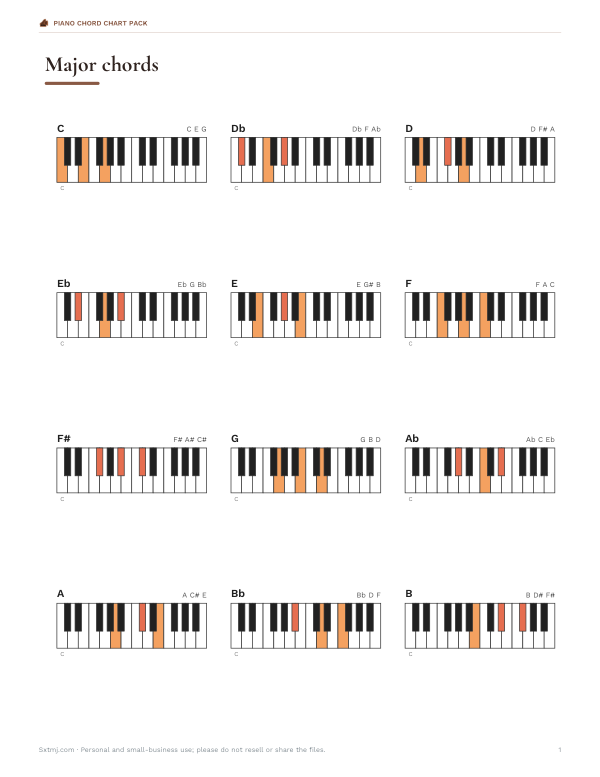
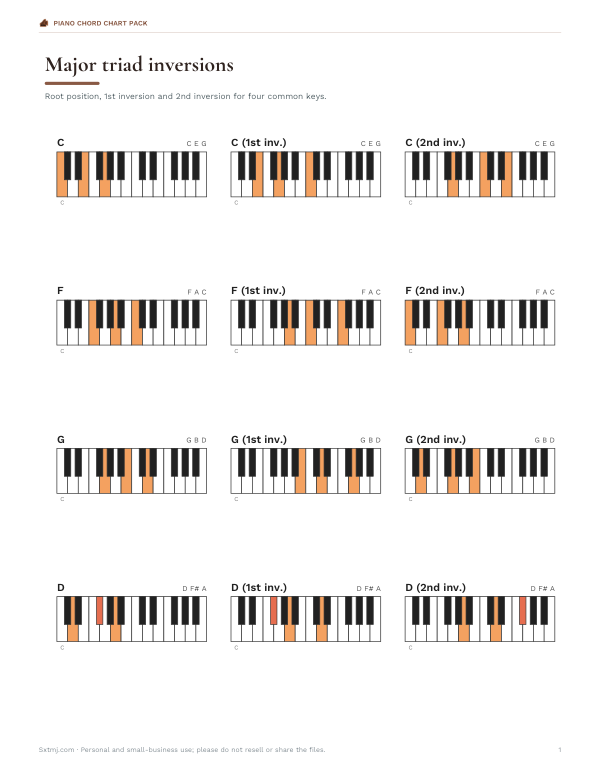
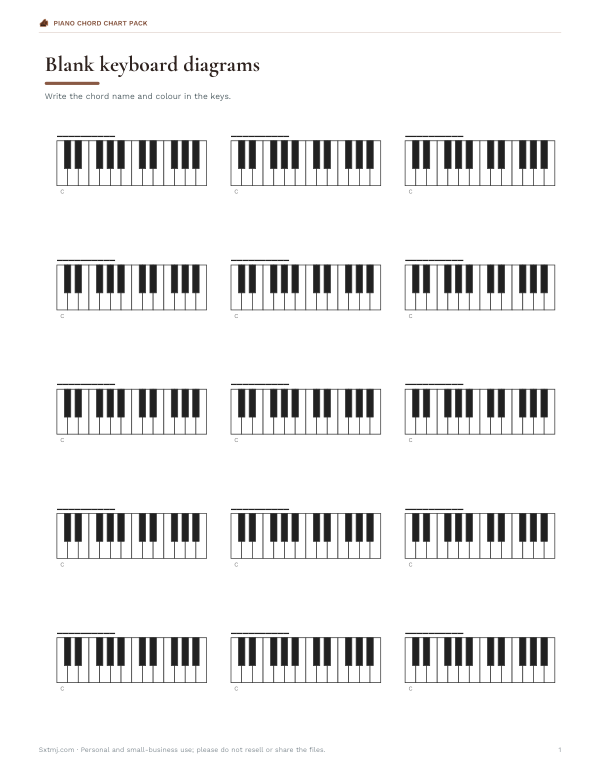
Piano chord finder and sheet maker
Chord sheet for a progression
Piano Chord Chart Pack
Printable piano chord charts with keyboard diagrams: major, minor, dominant 7th, major 7th and minor 7th in all 12 keys, a triad inversion chart, blank keyboard diagram sheets and a chord formula card.
- Chord charts, all keys (PDF)
- Inversion chart (PDF)
- Blank keyboards (PDF)
- Formula card (PDF)
Formats: PDF. Instant download after payment (link valid 72 hours, up to 5 downloads). AI-assisted: the templates were drafted with AI help and reviewed and laid out before publishing.
$4.00 USD, one-time 4 files · about $1.00 each
- Instant download
- 7-day refund
- Secure checkout by Stripe
7-day money-back guarantee. Full refund within 7 days of purchase, even after you download.
Free sample: Blank Keyboard Diagrams (PDF, 61 KB)
Full refund within 7 days — see the refund policy and license.
Free printables
Single sheets you can print right now, no sign-up. The full pack adds every sheet in one download plus the editable files.
 Printable Piano Chord Formula Chart
How to read a piano chord diagram
Each diagram shows two octaves of a piano keyboard starting on C. Highlighted keys are the notes to press together; orange marks white keys and red marks black keys, with the note names printed underneath. “C” is the white key just to the left of each group of two black keys — middle C is the one nearest the middle of a full-size piano. The diagrams show one common hand position; you can play the same notes in any octave.
Chord formulas
| Chord type | Symbol | Formula | Example in C |
|---|---|---|---|
| Major | C | 1 3 5 | C E G |
| Minor | Cm | 1 b3 5 | C Eb G |
| Dominant 7th | C7 | 1 3 5 b7 | C E G Bb |
| Major 7th | Cmaj7 | 1 3 5 7 | C E G B |
| Minor 7th | Cm7 | 1 b3 5 b7 | C Eb G Bb |
| Diminished | Cdim | 1 b3 b5 | C Eb Gb |
| Augmented | Caug | 1 3 #5 | C E G# |
| Suspended 2nd / 4th | Csus2 / Csus4 | 1 2 5 / 1 4 5 | C F G |
| Half-diminished | Cm7b5 | 1 b3 b5 b7 | C Eb Gb Bb |
| Diminished 7th | Cdim7 | 1 b3 b5 bb7 | C Eb Gb Bbb |
| Add9 | Cadd9 | 1 3 5 9 | C E G D |
Numbers count scale steps from the root of the major scale: b means a semitone lower, # a semitone higher. Notes are spelled by letter, so Cdim7 is C Eb Gb Bbb — the last note is played on the A key.
Major and minor chords in every key
| Root | Major chord | Notes | Minor chord | Notes |
|---|---|---|---|---|
| C / C | C | C E G | Cm | C Eb G |
| Db / C# | Db | Db F Ab | C#m | C# E G# |
| D / D | D | D F# A | Dm | D F A |
| Eb / Eb | Eb | Eb G Bb | Ebm | Eb Gb Bb |
| E / E | E | E G# B | Em | E G B |
| F / F | F | F A C | Fm | F Ab C |
| F# / F# | F# | F# A# C# | F#m | F# A C# |
| G / G | G | G B D | Gm | G Bb D |
| Ab / G# | Ab | Ab C Eb | G#m | G# B D# |
| A / A | A | A C# E | Am | A C E |
| Bb / Bb | Bb | Bb D F | Bbm | Bb Db F |
| B / B | B | B D# F# | Bm | B D F# |
Inversions
An inversion plays the same notes with a different one at the bottom. C major in root position is C–E–G; first inversion is E–G–C; second inversion is G–C–E. Inversions let your hand move smoothly between chords — for example C (C–E–G) to F in second inversion (C–F–A) keeps C under your thumb and moves the other fingers only one or two keys. Slash chords such as G/B name the bass note directly: play B in the bass (left hand) with a G chord above it.
Chords in a key
| Key | I | ii | iii | IV | V | vi | vii° |
|---|---|---|---|---|---|---|---|
| C major | C | Dm | Em | F | G | Am | Bdim |
| G major | G | Am | Bm | C | D | Em | F#dim |
| D major | D | Em | F#m | G | A | Bm | C#dim |
| A major | A | Bm | C#m | D | E | F#m | G#dim |
| F major | F | Gm | Am | Bb | C | Dm | Edim |
| Bb major | Bb | Cm | Dm | Eb | F | Gm | Adim |
| Eb major | Eb | Fm | Gm | Ab | Bb | Cm | Ddim |
Most pop, folk and worship songs use mainly the I, IV, V and vi chords of their key. The very common I–V–vi–IV progression is C–G–Am–F in C major and G–D–Em–C in G major.
Worked example
A singer finds C – G – Am – F too low. The pianist types the progression into the sheet builder and presses Transpose +1 twice to get D – A – Bm – G — the notes are D (D F# A), A (A C# E), Bm (B D F#), G (G B D). For the verse they choose Am7 in first inversion from the chord finder, which gives C–E–G–A from the bottom, then print the sheet for the music stand.
Left-hand patterns for beginners
- Block chords: play the whole chord on the first beat of each bar.
- Root and fifth: left hand plays the root and the fifth (C and G for C major) while the right hand plays the chord.
- Broken chords: play the notes one after another, bottom to top (an arpeggio).
- Octave bass: left hand plays the root in octaves on beats 1 and 3.
- Alberti bass: bottom–top–middle–top, a classical pattern.
Printing and privacy
Chord sheets print on one page for up to about 16 different chords; repeated chords appear once. Everything runs in your browser — nothing you type is uploaded.
Frequently asked questions
How do I read piano chord charts?
Press the highlighted keys together; note names are printed under each key.
What notes are in a C major chord?
C, E and G.
What is a chord inversion?
The same notes with a different note at the bottom, e.g. E–G–C for C major.
What does G/B mean?
A G chord with B in the bass.
How do I transpose a song?
Move every chord up or down by the same number of semitones; the sheet builder does it for you.
Can I hear the chord?
Yes — press Play chord for a simple synthesised preview.